

I’ve been kind of obsessed with prediction markets lately. What’s interesting about them is they’re a continuously updated source of real-world validated questions. People put real money on outcomes, so there’s actual stakes behind getting the resolution criteria right. And then the thing either happens or it doesn’t, and you know.
Most datasets don’t have this. You have labels that some annotator applied, or synthetic data, or stuff where the “ground truth” is actually just another model’s opinion. Prediction markets are different—the world tells you if you were right.
Which makes them really interesting to build a benchmark from, which I’m calling KalshiBench. It is 1,531 questions from Kalshi (a CFTC-regulated exchange) spanning politics, sports, entertainment, crypto, climate, a bunch of categories. The idea was to test whether LLMs are calibrated—when they say they’re 80% confident, are they right 80% of the time?
The part I find theoretically interesting is the following: Most LLM benchmarks test logical reasoning—”given these premises, what follows” or “given this passage, answer this question.” The model operates in a fake world defined by the prompt, and you check if it’s internally consistent.
KalshiBench is different. We’re asking “will this bill pass,” “will this team win,” “will this stock hit this price.” The model has to use its world model—its implicit understanding of how politics, sports, markets actually work. And then we check that against what happened. Essentially, we’re testing epistemic reasoning or commonsense reasoning. The model needs to know that a team that just lost three star players is less likely to win, that a controversial bill faces longer odds in a divided congress, that crypto is volatile. You can’t chain-of-thought your way to this, nor can you recall facts from before to apply. You have to have a decent model of how the world works in order to provide accurately calibrated confidence scores.
The Dataset
I scraped a few million questions from Kalshi, cleaned things up, deduplicated (limiting to 2 questions per series ticker to avoid redundancy), ended up with 1,531 questions across 16 categories. For the eval I filtered to questions resolving after October 2025 (so after model training cutoffs—they genuinely can’t know the answer) and sampled 300 questions. 40/60 yes/no split. 300 is pretty standard for this kind of thing—ARC-AGI is 100-200 questions, ForecastBench(prior art here) uses 200 for their evals.
Dataset: huggingface.co/datasets/2084Collective/kalshibench-v2
Code: github.com/2084collective/kalshibench
All the code for creating the benchmark as well as benchmarking the dataset itself is in the above repo.
The Models
I tested Claude Opus 4.5, GPT-5.2-XHigh (the extended reasoning one), DeepSeek-V3.2, Qwen3-235B-Thinking, and Kimi-K2. All have training cutoffs at or before October 2025.
The prompt told models explicitly to be calibrated—”if you’re 70% confident, you should be correct about 70% of the time on similar questions.”
Results


Some explanation of the terms here:
Brier Score is mean squared error for probability predictions:
You predict a probability p_i, the outcome y_i is 0 or 1, you take the squared difference and average. Intuition: if you predict 80% and it happens, your error is (0.8 - 1)^2 = 0.04. If you predict 80% and it doesn’t happen, your error is (0.8 - 0)^2 = 0.64. So the scoring rule rewards being confident when right and uncertain when wrong. 0 is perfect, 0.25 is what you’d get predicting 50% on everything, 1 is maximally wrong. Human superforecasters typically get 0.15-0.20.
Brier Skill Score (BSS) measures improvement over just predicting the base rate. Positive means you’re adding value, negative means you’d literally do better ignoring the question and always guessing 40%.
Expected Calibration Error (ECE) bins your predictions by confidence level and measures the average gap between confidence and accuracy in each bin. Intuition: take all predictions where you said 70-80% confidence. What fraction did you actually get right? If it’s 75%, you’re calibrated in that bin. If it’s 50%, you’re overconfident by 25 percentage points. ECE averages these gaps across all bins, weighted by how many predictions are in each. Lower is better, 0 is perfectly calibrated.
Claude is noticeably ahead here. Only model with positive BSS. ECE is 2-3x better than the rest. It’s still overconfident—12 percentage point gap on average—but it’s doing something the others aren’t.
Full Reliability Diagrams
A reliability diagram plots predicted confidence against actual accuracy across binned predictions. A perfectly calibrated model follows the diagonal—when it expresses 70% confidence, it should be correct 70% of the time. Here’s the full data for all models across 10 confidence bins:
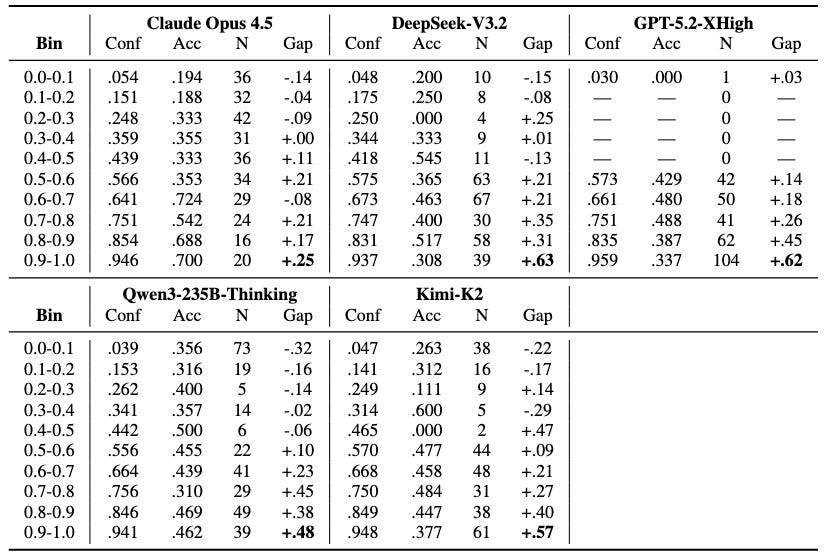
Gap = Conf - Acc, so positive means overconfident. Notice GPT-5.2-XHigh has basically no predictions below 50% confidence—it put 104 of 300 predictions in the 90-100% bin where it’s only 34% accurate.
Extended Reasoning Made Things Worse?
I was surprised by this. GPT-5.2-XHigh uses extended reasoning—about 2M tokens vs Claude’s 138K for the full eval. Cost $30 vs $12. And it had the worst calibration.
I don’t really know why. Maybe longer reasoning chains just reinforce the initial hypothesis instead of actually updating. Maybe the training signal for extended reasoning optimizes for sounding convincing. Would need to see the training setup to know.
Superforecasters get Brier scores around 0.15-0.20 on similar stuff. Claude’s 0.227 is approaching that. But superforecasters have much better calibration (ECE around 0.03-0.05), so there’s still a gap specifically in knowing what you don’t know.
Caveats
Some things I’m not fully confident about:
I only tested verbalized confidence. Logit-based approaches might look different.
Used one prompt format, didn’t test sensitivity to prompt variations.
Data is from a few months ago, since real-world stuff led me to be super busy for the last few months - I encourage anyone that wants to run this on the newer models too!
Takeaways
Claude is remarkably well calibrated in comparison to other LLMs which speaks volumes for the accuracy and coherence of its world model, and probably has bearing on why it has such good “model feel”. GPT 5.2 is surprisingly badly calibrated and overconfident, which, while its accuracy is still pretty good, probably helps explain why some of the vibes there are pretty off - you genuinely can’t trust what its saying.
Paper: arxiv.org/abs/2512.16030
Code and data: github.com/2084collective/kalshibench